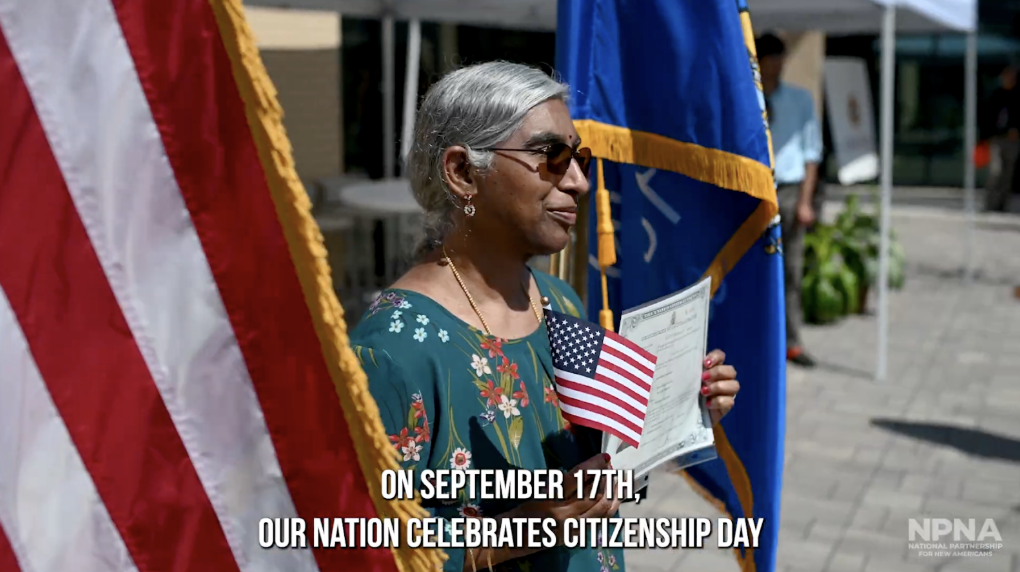
This digital toolkit offers ways to uplift our network and partners’ citizenship day activities throughout the month of September. Together, we hope to encourage eligible lawful permanent residents to take the final step on their immigration journey by highlighting the benefits of citizenship. In this toolkit you will find:
Wednesday, September 17th, 2025 is Citizenship Day, but National Partnership for New Americans (NPNA) and Cities & Counties for Citizenship (CC4C) are taking it a step further and proclaiming the month of September to be “Citizenship Month”. A month to celebrate new Americans who have taken the step to become U.S citizens, encourage eligible immigrants to become U.S. citizens, and celebrate what it means to be a U.S. citizen in a multiethnic, multicultural democracy.
Promoting Citizenship in this Moment
It is not an ordinary time and we fully acknowledge the grave threats facing immigrant communities across the nation. At the same time, we believe it’s important for organizations to continue to encourage eligible residents to become citizens as this continues to be the strongest protection from deportation. Below we offer ways to hold these two truths in a way that shows unity and solidarity.
Necessary precautions, increase screening & preparation support for LPRs
Access Trusted Legal Support: It is more important than ever for people to consult with an attorney or a DOJ Accredited Representative before submitting their application for naturalization. Find a trusted legal service provider here: https://readytostay.org/find-help
Assess Risks: Check out this resource which offers tips on risk assessment for naturalization applicants
Knowledge is Power:
Stay up to date in the event of changes to the naturalization test. While it has been announced that these may change although no further details or dates have been announced.
Know the latest changes to the process/ eligibility. Ex: Recent announcement of new criteria for determining “good moral character.”
Check out this explainer put together by NPNA and partners on denaturalization for practitioners and stay up to date on the latest developments
We advocate to protect our communities and to protect citizenship
An injury to immigrants of any status is an injury to all of us. Let’s ensure that in our messaging we are not differentiating between protection for those who have lawful pathways and those who don’t.
Citizenship itself has been and will likely continue to be under threat and we must continue to advocate to keep it as accessible as possible.
Encouraging those eligible to naturalize to seek a trusted provider for legal services and support
In this rapidly changing policy landscape, the evergreen call for permanent protections is more important than ever. Citizenship remains an important way to attain permanent status for those who are eligible. Here are some of the benefits to uplift at this time:
Right to vote
US passport allows you to travel and return more safely
Adjust status for family members
Likelihood to increase annual earnings
II. How to engage in Citizenship Day 2025
On September 17, 2025 the nation observes citizenship and constitution day- a day that immigrant rights advocates have adopted to uplift a unified rallying call to action for the more than 9 million people eligible to naturalize across the nation.
We hope your organization will join us- especially if you have upcoming naturalization events, ongoing classes, or citizenship clinics.
Here are 3 ways to participate:
Share our “Call to Naturalize [English | Spanish Subs HERE]” video on your social media on Wednesday September 17, 2025 and join dozens of other organizations as we create momentum on socials to reach a wide range of community members with this important message.
Today on #CitizenshipDay2025 we recognize that naturalization is more than a status change; it is a declaration of belonging. It ensures that our communities are not just spoken about, but are the ones speaking, deciding, and shaping the future. YOUR ORG NAME is proud to join @npnewamericans on this national day of action as we stand united to #ProtectCitizenship and support community members on their journey to naturalization.
ADD INFO HERE ABOUT AN UPCOMING CITIZENSHIP EVENT OR CLASSES / PROGRAMMING HELD BY YOUR ORG OR LOCAL PARTNERS OR OTHER CALL TO ACTION THAT BRINGS PEOPLE INTO YOUR WORK.
Holding a naturalization event and sharing on social media? Be sure to tag @npnewamericans so that we can uplift.
Post and share digital content from this toolkit (see next section) all month long!
On July 14, the U.S. Department of Health and Human Services (HHS) published a notice in the Federal Register that re-interprets the meaning of “Federal public benefit” in the 1996 welfare law. In doing so, the notice restricts eligibility to a narrow set of “qualified immigrants” and leaves out many lawfully residing immigrants. See Table B below for more details.
The notice takes effect on July 14, 2025, but HHS also provides a 30 day comment period that ended on 8/13/2025. The PIF Coalition comment signed by nearly 400 organizations is available here. Update 8/7/25: HHS posted an update that, on a nationwide basis, it will not enforce this notice until September 11, 2025. This is likely in response to a lawsuit filed by 21 states against the Trump administration to block the notice. As part of the lawsuit, the states and HHS recently agreed to a stipulation that HHS would not enforce the PRWORA notice until September 11th in the states that are plaintiffs in the lawsuit. In other words, the notice does not apply until September 10th in the following states: Arizona, California, Colorado, Connecticut, District of Columbia, Hawaii, Illinois, Maine, Michigan, Massachusetts, Maryland, Minnesota, Nevada, New Jersey, New Mexico, New York, Oregon, Rhode Island, Vermont, Wisconsin, and Washington. Learn more about the notice in our explainer below.
The notice says that HHS considers an additional 13 programs as “Federal public benefits” with eligibility restricted to qualified immigrants. These include Head Start, Community Health Centers, the Title X family planning program, and the Community Services Block Grant (CSBG). See Table A below for more details. HHS also recognizes that some services designated as “federal public benefits” may nevertheless fit within one of the statutory exemptions, such as testing and treatment of communicable disease symptoms. This notice does not change eligibility for Medicaid or CHIP and states that provide coverage to lawfully residing immigrant children and pregnant people can continue to do so.
This HHS notice did not address PRWORA’s verification requirements. It confirms that non-profit charitable organizations are not required to verify immigration status. But it did not provide details on how verification of status might occur.
More Details
Programs HHS Considers as Federal Public Benefits
The 1996 welfare law provided a general definition of the “Federal public benefits” that are subject to its “qualified immigrant” eligibility restrictions. With some important exceptions, the welfare law allowed Federal agencies to determine which of their programs were restricted by the law and which were exempt from restriction.
On July 14, 2025, almost thirty years after passage of the 1996 welfare law, and more than 25 years after HHS published its initial notice, the agency published a notice reinterpreting this term. The notice takes effect immediately (based on the rationale that any delay would be contrary to the public interest and fail to address the ongoing emergency at the Southern Border of the U.S.), but also grants a 30 day comment period.
Table A below lists the programs that HHS considered to be “Federal public benefits” in the initial August 4, 1998 notice , and in the notice published on July 14, 2025. “Federal public benefits” are subject to “qualified immigrant” eligibility restrictions. The notice says that this list is not exhaustive. Any programs not listed in this notice or established after the date of this notice may still fall under the definition of Federal public benefit. Any additional programs determined to be Federal public benefits will be announced in program specific guidance. However, the notice does not change eligibility for Medicaid or CHIP and states that cover lawfully residing immigrant children and pregnant people can continue to do so.
In the July 10, 2025 notice, HHS’ recognized that some services designated as “federal public benefits” may nevertheless fit within one of the statutory exemptions, such as testing and treatment of communicable disease symptoms.
Qualified Immigrants
“Qualified immigrants” under the welfare law –the Personal Responsibility and Work Opportunity Reconciliation Act of 1996 (PRWORA) – are eligible for Federal public benefits programs. They include lawful permanent residents (LPRs) or people with a green card, refugees, people granted asylum or withholding of deportation/removal, and conditional entrants; people granted parole by the U.S. Department of Homeland Security (DHS) for a period of at least one year; Cuban and Haitian entrants; certain abused immigrants, their children and/or their parents; certain survivors of trafficking; and individuals residing in the U.S. pursuant to a Compact of Free Association (COFA).
Many lawfully residing immigrants, who are not listed as “qualified immigrants,” are ineligible for “Federal public benefits” programs. These immigrants include people with Temporary Protected Status; applicants for adjustment to LPR status with approved visa petitions; applicants for asylum or withholding of deportation/removal; people paroled for less than one year, granted deferred enforced departure, or deferred action; special immigrant juveniles; U Visa Holders, people with valid nonimmigrant visas, and more.
Table B Below provides details.
Verification Requirements
This HHS notice did not address PRWORA’s verification requirements. It confirms that non-profit charitable organizations are not required to verify immigration status. But it did not provide details on how verification of status might occur.
Costs and Savings
In addition to any savings that may be achieved by excluding lawfully residing people from health and human services programs, HHS notes millions of dollars in new administrative costs for individuals to document their eligibility, and the government to review their eligibility, and for programs to revise their eligibility and operating procedures.
Table A: Programs HHS Considers to Be “Federal Public Benefits” Restricted to “Qualified” Immigrants
Administration on Developmental Disabilities – State Developmental Disabilities Councils (direct services only)
✔️
✔️
ADD– Special Projects (direct services only)
✔️
✔️
ADD- University Affiliated Programs (clinical disability assessment services only)
✔️
✔️
Adult Programs/ Payments to Territories
✔️
✔️
Agency for Health Care Policy and Research Dissertation Grants
✔️
✔️
Child Care and Development Fund
✔️
✔️
Clinical Training Grant for Faculty Development in Alcohol and Drug Use
✔️
✔️
Foster Care
✔️
✔️
Health Profession Education and Training Assistance
✔️
✔️
Independent Living Program
✔️
✔️
Job Opportunities for Low Income Individuals (JOLI)
✔️
✔️
Low Income Home Energy Assistance Program (LIHEAP)
✔️
✔️
Medicare
✔️
✔️
Medicaid (except assistance for an emergency medical condition)
✔️
✔️
Mental Health Clinical Training Grants
✔️
✔️
Native Hawaiian Loan Program
✔️
✔️
Refugee Cash Assistance
✔️
✔️
Refugee Medical Assistance
✔️
✔️
Refugee Preventive Health Services Program
✔️
✔️
Refugee Social Services Formula Program
✔️
✔️
Refugee Social Services Discretionary Program
✔️
✔️
Refugee Targeted Assistance Formula Program
✔️
✔️
Refugee Targeted Assistance Discretionary Program
✔️
✔️
Refugee Unaccompanied Minors Program
✔️
✔️
Refugee Voluntary Agency Matching Grant Program
✔️
✔️
Repatriation Program
✔️
✔️
Residential Energy Assistance Challenge Option (REACH)
✔️
✔️
Social Services Block Grants (SSBG)
✔️
✔️
State Child Health Insurance Program (CHIP)
✔️
✔️
Temporary Assistance for Needy Families (TANF)
✔️
✔️
Title X Family Planning Program
✔️
Head Start
✔️
Title IV-E Educational and Training Voucher Program
✔️
Community Services Block Grant (CSBG)
✔️
Health Center Program
✔️
Substance Use Prevention and Recovery Support Services Block Grant
✔️
Community Mental Health Services Block Grant
✔️
Projects for Assistance in Transition from Homelessness Grant Program
✔️
Certified Community Behavioral Health Clinics
✔️
Mental Health and Substance Use Disorder Treatment, Prevention and Recovery support Services Programs administered by the Substance Abuse and Mental Health Services Administration not otherwise covered under 37-40.
✔️
Title IV-E Prevention Services Program
✔️
Title IV-E Kinship Guardianship Assistance Program
✔️
Health Workforce Programs not otherwise covered under 10 above (including grants, loans scholarships, payments and loan repayments).
✔️
Note 1: The notice says that this list is not exhaustive. Any programs not listed in this notice or established after the date of this notice may still fall under the definition of Federal public benefit. Any additional programs determined to be Federal public benefits will be announced in program specific guidance.
Note 2: The notice does not change eligibility for Medicaid or CHIP and states that cover lawfully residing immigrant children and pregnant people can continue to do so.
Table B: Qualified Immigrants and Lawfully Residing Immigrants
Qualified Immigrants
Lawfully Residing Immigrants
Lawful permanent residents (LPRs) or people with green cards
✔️
✔️
Refugees and people granted asylum
✔️
✔️
People granted withholding of deportation/removal,conditional entrants
✔️
✔️
People granted parole by the U.S. Department of Homeland Security (DHS) for a period of at least one year;
✔️
✔️
Cuban and Haitian entrants;
✔️
✔️
Certain abused immigrants, their children and/or their parents;
✔️
✔️
Certain survivors of trafficking;
✔️
✔️
Individuals residing in the U.S. pursuant to a compact of free association (COFA).
✔️
✔️
People with Temporary Protected Status
✔️
Applicants for adjustment to LPR status with approved visa petitions
✔️
Applicants for asylum or withholding of deportation/removal
✔️
People paroled for less than one year, with deferred enforced departure, or deferred action
✔️
Special immigrant juveniles
✔️
U Visa Holders
✔️
People with valid nonimmigrant status or nonimmigrant visas
✔️
Longtime Residents
✔️
People under an order of supervision who have employment authorization
✔️
People granted Family Unity
✔️
Applicants for the following statuses, who have been granted employment authorization:Cancellation of removal or suspension of deportationAdjustment under the LIFE ActLawful Temporary Residents and Applicants for Legalization under the IRCARegistry
The Immigrant and Refugee Support Group (IRSG ) has a fund available for immigrant community members who need help posting bond, paying legal fees and/or need commissary support in detention.
Mission: Envisions a community that cares for all of its members and in which all migrants who seek safety and freedom from oppression and harm are welcomed to the United States – and to New Hampshire, if they choose – with dignity and compassion. We respect the personal power and agency of the immigrants in our midst as the decision makers in their own lives, and we understand our role as offering support and accompaniment whenever we are privileged to do so. We are guided by our faith and by love as we dedicate ourselves to the quest for justice and welcome for all.
Over 14% of the United States population is composed of immigrants. But in reality, the vast majority of Americans today are here because of relatives who immigrated from other countries some time in the last several hundred years.
And while the distinctive American culture and spirit is the result of blending many diverse cultures and histories, the United States has for centuries had an up-and-down relationship with immigration.
Each era of immigration has been met with reductive ideas and resistance, whether the backlash was directed toward the Chinese, Irish, Italians, or Mexicans. Immigration laws have targeted specific groups at various times, stoking intolerance and preventing people from truly joining American society. Over time, however, as laws changed to be more equitable and immigrants found their footings, we have reaped the rewards of innovation in business, music, art, literature, dance, food, societal norms, entertainment, and sports—all while realizing a greater understanding of and respect for different cultures, religions, and ideas.
Stacker compiled a list of the biggest sources of immigrants to New Hampshire using data from the U.S. Census Bureau. Countries are ranked by the highest number of residents according to 2023 5-year estimates, the most recent data available as of 2025. Keep reading to find out more about the immigrant community in your home state.