MANCHESTER — Municipal, state, and federal policies impacting workers, including immigrant workers, will be highlighted at an International Workers Day Rally at City Hall in Manchester on Monday, May 2 at 4:30 p.m.
“All workers deserve to be treated with dignity,” said Eva Castillo of the NH Alliance for Immigrants and Refugees, who will serve as emcee. “That means safety in the workplace, a living wage, and the right to organize unions.”
Castillo, who has led May Day rallies every year since 2006, alongside Arnie Alpert from the American Friends Service Committee (AFSC), said she expects speakers to highlight multiple issues affecting workers in New Hampshire – including low wages, lack of affordable housing, exposure to COVID and other health hazards, and discrimination. Speakers will rally support for a municipal resolution in favor of $15/hour for Manchester city employees; union organizing by student workers at Dartmouth College; dignity, respect and fair contracts for public employees; an end to the attacks on NH public school teachers and students; labor laws that protect workers’ rights to organize and bargain collectively; and a pathway to citizenship for immigrant workers.
In addition to the NH Alliance for Immigrants and Refugees, other rally sponsors are Raise Up NH, AFSC, the Economic Justice Mission Group of the NH Conference United Church of Christ, Rights and Democracy, the Granite State Organizing Project, NH Council of Churches, Granite State Interfaith Action Fund, the Immigrant Solidarity Network, NH Voices of Faith and the NH Faith & Labor Coalition.
The rally will be live streamed.
Observed throughout the world as a day to highlight the rights of workers, the first of May has been re-popularized in the United States since 2005, when immigrant workers rallied in several major cities. Locally, Castillo said immigrant solidarity and labor activists have gathered for International Workers Day annually since 2006, with rallies held in Manchester, Nashua, Portsmouth, Dover, Durham, and Concord.
Article originally published on Manchesterinklink.com, a founding member of the Granite State News Collaborative.
This article is one in an occasional series about New Hampshire immigrants, their challenges and contributions. More than 48,000 immigrant workers made up 6 percent of the state’s labor force in 2018, according to the U.S. Census Bureau.
Mentoring developmentally disabled youth in New Hampshire may not seem like a logical career step for a former bank manager from the Democratic Republic of the Congo.
But for Bienfait, a Congolese immigrant – he declines to use his last name for reasons of personal safety – the job is highly satisfying.
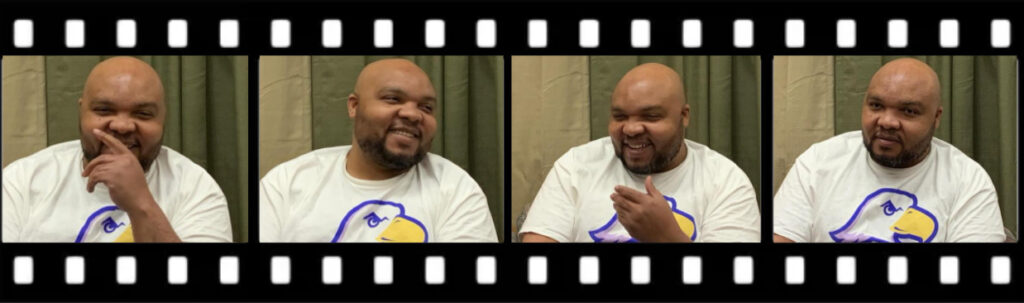
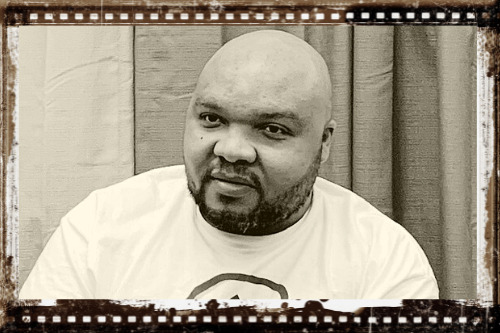
Wearing a school mascot tee shirt, Bienfait describes his New Hampshire career detour as a positive opportunity on his journey to personal and family safety.
Now residing in Manchester, Bienfait, an applicant for asylum, considers himself blessed to have a job with Sevita, formerly known as the Mentor Network, a nationwide company that provides services to those with intellectual and developmental disabilities.
“I work, work, work,” he said. “It’s hard. But the kids are my fun.”
Bienfait flew from the Congo to the United States in 2018, after his son had been kidnapped and he had been threatened. He and his family are Hutu, one of several ethnic groups in Africa that sometimes war with one another.
He decided to seek asylum in Canada, unaware of a bilateral agreement that allows the asylum-seeker to apply only in the country first entered.
Detained by U.S. Customs and Border Patrol agents near the Canadian border, Bienfait was transferred to the Strafford County Corrections facility in Dover, NH.
He spent 21 tense days there, unable to reach his wife in Africa and unsure of what to do.
A fellow detainee, a man from Haiti, changed Bienfait’s future.
“He knew I could speak French,” Bienfait says. And French was the only language the Haitian could speak.
“Frère peux tu m’aider à traduire?” Bienfait recalls his asking — “Brother, can you help me and translate?” The Haitian needed Bienfait’s help to communicate at a meeting with volunteers from the New Hampshire Immigrant Visitation Program and the American Friends Service Committee (AFSC).
Bienfait agreed. At the meeting, he realized that the volunteers could help him, too.
Within days, the New Hampshire Conference United Church of Christ (NHCUCC) and the AFSC, along with the American Civil Liberties Union (ACLU), had cooperated to raise the daunting $10,000 bail and arrange a host family for Bienfait.
The Unitarian Universalist Church in Manchester, which voted in 2017 to become a sanctuary facility, invited Bienfait to live at the church while waiting to find housing with a host family or on his own.
“He was just an amazing person,” Liz Alcauskas, a church member who worked closely with him, said in a phone interview. “One of the first things he wanted to do was get a library card.”
She said Bienfait checked out several CDs and books about banking in the United States.
“He wanted to integrate how our banking system works with his background.”
A donor bought Bienfait a bicycle.
“That helped me to go to buy food at MarketBasket,” he says.
Later he would receive a used car.
“A member of the church in Nashua had a car she wasn’t using,” Ms. Alcauskas said. “We bought it for a dollar and got it inspected. Meanwhile, Bienfait had been studying for the driver’s test when he didn’t even have a car,” she recalled. “Miracles happen.”
Bienfait says the red Toyota hybrid helped to get to his workplace at Crotched Mountain.”
“My angels,” as Bienfait describes them, not only helped him get out of detention, find housing and get transportation, but they also lined up classes in English as a Second Language and provided basic necessities. They got him the job at Crotched Mountain School, his first experience caring for youngsters with disabilities. After the school closed, he joined the team at Sevita.
Volunteers also accompanied him to meetings with immigration officials in Boston and took him to meet with his immigration attorney.
Ann Podlipny, a resident of Chester NH, was his interpreter during the intense process.
“It was a huge relief and a great victory to be granted asylum, finally, after Bienfait’s ordeal,” Ms. Podlipny wrote in an email.
Today Bienfait’s first priority is to bring his wife and their eight children, ranging in age from 5 to 24, to the United States. He thinks he’ll be able to do it in three or four years. Banking still holds some interest for him. So does the possibility to get a doctorate from the Carsey School of Public Policy at the University of New Hampshire.
Back in Goma, the Congolese capital, Bienfait said he managed a bank and taught economics at the local university where he’d earned a bachelor’s degree. It was a good life, he says, until his family was targeted by terrorists.
“It was not safe,” he says.
He rented a house in Kampala, the capital of the neighboring country of Uganda, for his wife and children. He booked himself a flight to the United States. After arriving, hearing about the “zero tolerance” program initiated by the Trump Administration alarmed him: “It was always on the television news.”
Under the policy, devised to manage an influx of refugees from Honduras, Bienfait feared he, too, could be sent home, endangering his life. Canada, he thought, might be safer.
He called his wife to share his plan and said he’d call from Canada.
It was the last time they would speak for 21 tense days.
U.S. Customs officials near the Canadian stopped him. They explained that he was not eligible to apply for asylum in Canada because he had landed first on U.S. soil. They assigned him to the Strafford County center.
From there, he tried to call his wife but could not get a phone connection.
“I cried for almost 20 days,” he remembers.
Then he met the ACLU attorney, who telephoned Bienfait’s wife in Uganda.
“When she heard his voice,” Bienfait says, “she was shocked and hung up.”
She couldn’t understand who the attorney was or whether it was safe to talk with him, he explains. The attorney called back and put Bienfait on the phone.
“She cried,” he says. “Me, too.”
Now they’re in touch every day on WhatsApp, planning for the future.
“I was coming from problems,” he says of his arrival in America. “I said to myself, ‘This is a good opportunity. A new life is going to start now.’ ”
Bienfait’s Advice to Immigrants and Aid Providers
Take advantage of pro bono lawyers and volunteers who work with groups like the NHCUCC, Unitarian Universalist sanctuary and AFSC. They have been checked out and trained to help.
Learn the English language. People who can help often speak only English or perhaps English and Spanish. Classes in English as a Second Language are sometimes available in detention centers.
Online translation services can be unreliable. “One word can have five or six senses. It’s a big problem.”
Make sure you and the people you meet really understand each other. “Some detainees have been traumatized where they came from.” Be tolerant.
Think of food as a learning process. Some immigrants are unfamiliar with American food and how it’s prepared. Others are accustomed to eating a few small meals a day, not three larger ones. What’s strange at first may become welcome. “Now I love mashed potatoes.”
Gloria B. Anderson is a former New York Times news executive who worked in editorial and international development for the News Services division. Julie Zimmer is a former communications instructor at Kirkwood Community College in Iowa. She is active in the New Hampshire immigration advocacy network. Anderson and Zimmer live in Peterborough. They may be reached by email at gba@gba-global.com
This is the first in an occasional series, New in New Hampshire, that highlights the personal stories of immigrants in New Hampshire and Granite State citizens involved in their resettlement and success.
Itwas winter. It was snowing in New Hampshire. She was driving on a highway. A pick-up truck pulled beside her car. The driver gave her the middle finger. Behind her, the driver of another vehicle did the same.
“At first I wondered, ‘What have I done wrong?’ But then I thought, ‘OK, I’m not a white person. I forgot about that.’ If people can do that to me, what about my friends?”
The Rev. Sandra Pontoh, Maranatha Church, Madbury, NH
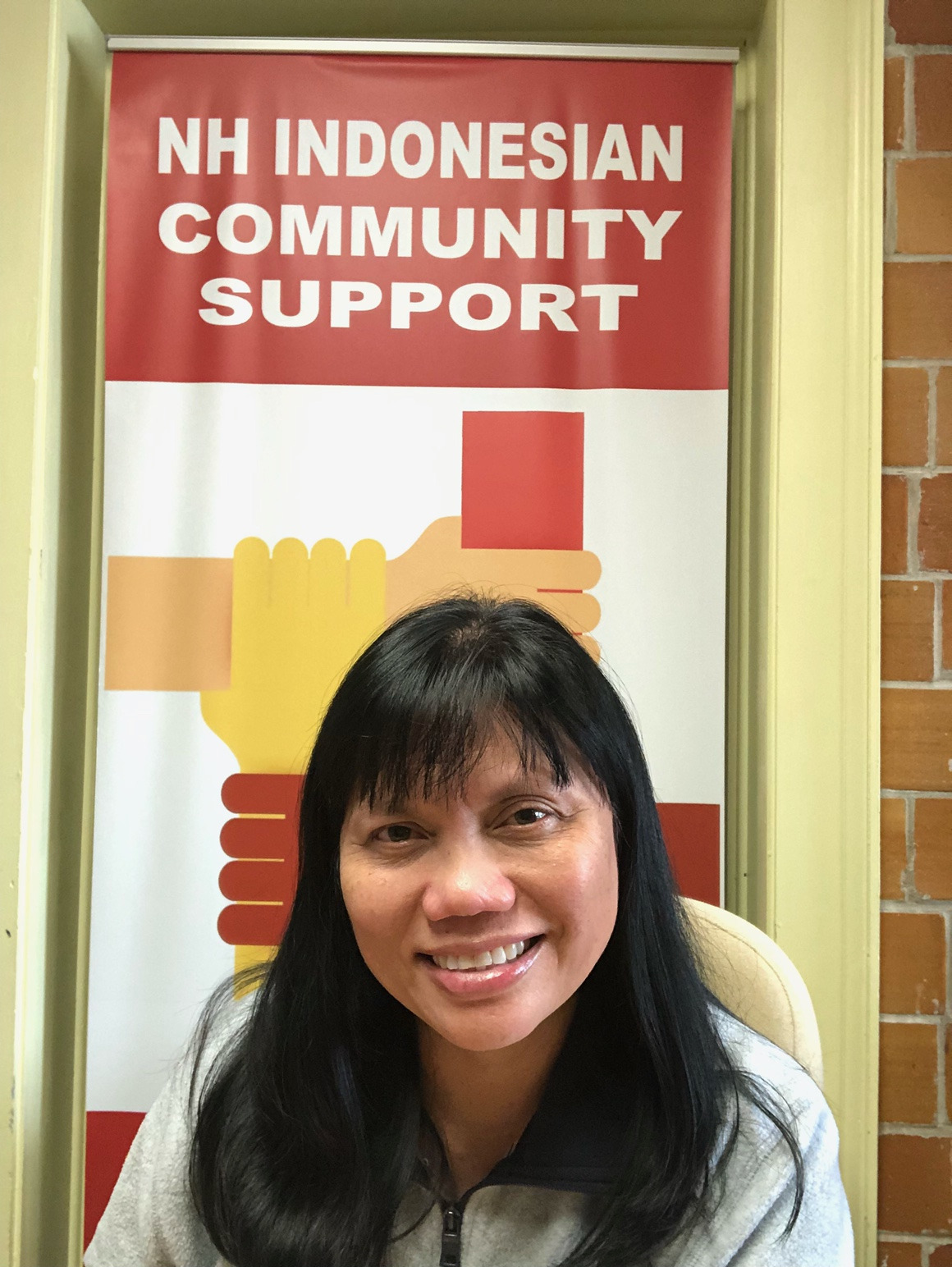
The Rev. Sandra Pontoh, founder and pastor of the Maranatha Indonesian UCC Church in Madbury, NH, has lived in the United States since 1998 when she arrived in Michigan to study theology at Western Theological Seminary. She had an F1 visa, for international students studying in the United States, thanks to assistance from her home church in Indonesia.
She didn’t foresee that, while she was in Michigan, she would get a call from a group of fellow Indonesians in New Hampshire asking her to form a new congregation.
“They said they’d been going to a white church and needed someone they could understand,” she said. Besides speaking English, Rev. Pontoh is fluent in several dialects as well as Bahasa, the official Indonesian language.
She agreed, moved east, and established what is now the Imanuel Indonesian Lutheran Church in Newington. A few years later, in 2004, she led the founding of the Maranatha Church in Madbury.
While her main job remains caring for the spiritual needs of her church, Rev. Pontoh said Indonesians also face mundane, down-to-earth challenges, including how to navigate the rules and regulations of the U.S. immigration system.
In 2020 Rev. Pontoh turned the church’s mission committee into New Hampshire Indonesian Community Support (NHICS), a non-profit organization with volunteers to help with matters such as advocating, translating and interpreting, counseling and referrals. On-call to interpret at courts and local hospitals, Rev. Pontoh donates what she’s paid to the non-profit.
About 2,000 Indonesians have settled in New Hampshire, some fleeing religious persecution, Rev. Pontoh said. Many Indonesian Christians arrived after a wave of radical Islam emerged in Indonesia, a majority-Muslim nation, in the late 1990s.
While many of the immigrants had college degrees, Rev. Pontoh said they took whatever jobs they could find, including washing dishes or cleaning houses, being paid “under the table.”
“Imagine,” she said they would tell her, “I never did this in my country. Now I’m cleaning someone else’s toilet.”
As they have learned English and gained work permits, many have found better jobs in manufacturing and other fields requiring their skills, she added.
In recent months Rev. Pontoh’s been fielding frequent calls including from other Indonesian pastors in NH and other states who are concerned about excessive delays in renewing work permits for asylum-seekers in their congregations.
Until last year, the renewals from the United States Citizenship and Immigration Services were more or less routine, she said, but now immigrants may wait more than six months, a delay attributed in large part to understaffing at the USCIS.
When permits are delayed, some immigrants lose their jobs because, without USCIS authorization, employers cannot legally retain even valued employees, Rev. Pontoh explained.
The ministers say that economic insecurity and a bogged-down renewal process trigger fear and even post-traumatic stress disorder (PTSD) for some whose traumatic experiences led them to emigrate. Rev. Pontoh tries to help the immigrants navigate the system.
“These Indonesians are my friends, my family,” she said. Even though her own experience was different, she identifies with their fears.
“We’re always afraid because people will think we’re strangers. We don’t speak English well. We feel we’re not accepted.”
She encourages more friendliness.
“Even to say, ‘Hi, How are you?’ That’s really important. Just a smile. It’s a huge thing. It says, ‘You’re not alone.’”
Rev. Sandra Pontoh’s advice to new immigrants:
Find someone to trust
Find someone to help with learning English
Find someone to contact immigration attorneys or officials on your behalf
Go to a church or school
Find a leader who can take you to the office of the person you need to see
Gloria B. Anderson is a former New York Times news executive whose work included editorial and international development for the News Services division. E-mail: gba@gba-global.com. Julie Zimmer is a volunteer with Welcoming New Hampshire and the New Hampshire Immigrant Rights Network, and is a former communications instructor at Kirkwood Community College in Iowa. E-mail: juliecorkzim@gmail.com
The second issue of 603 Diversity Magazine is now available!
Visit 603diversity.com to view the digital edition or to order a print copy.
“603 Diversity Magazine is dedicated to sharing the stories at the intersections of business and culture in New Hampshire’s diverse communities. Each issue will feature profiles of New Hampshire’s business and arts leaders, guide readers to the wealth of locally-owned businesses in the state and explore the long history of diverse contributions to New Hampshire’s development into one of the highly ranked states in the country across a range of categories, from business and economy, to health care and opportunity.
603 Diversity’s mission is to educate readers of all backgrounds about the exciting accomplishments and cultural contributions of the state’s diverse communities, as well as the challenges faced and support needed by those communities to continue to grow and thrive in the Granite State.” –603diversity.com
Afghan evacuees are on their way to a new home in New Hampshire
By Julia Furukawa and Peter Biello, NHPR
Now that the Taliban has taken control of Afghanistan, the U.S. is expecting thousands of Afghans to arrive as they evacuate their home country, and some of them will be coming to New Hampshire.
Ascentria Care Alliance in Concord provides resettlement services to people coming to the U.S., and will be working to resettle Afghan evacuees in the Granite State, with the eventual goal of finding homes for 100 Afghans.
All Things Considered host Peter Biello spoke with Crissie Ferrara, the Program Manager for Services for New Americans at Ascentria, about their efforts to resettle Afghan refugees.
New Hampshire Public Radio
Listen to the interview and read the full article here:
New Hampshire preparing to welcome 125 Afghan evacuees
By Shawne K. Wickham, Union Leader
Two refugee resettlement agencies say they expect about 125 Afghans who were evacuated after the Taliban took over their homeland to be resettled in New Hampshire.
Ascentria Care Alliance in Concord expects to resettle about 100 Afghan evacuees, according to Crissie Ferrara, New Hampshire program manager for that agency’s Services for New Americans program.
“Many people were really scared for their lives and for their safety, for themselves and their families, and they felt this was the best option for them, and the only option to keep their families safe,” she said.
…
Emma Tobin, chief program officer at the International Institute of New England, said her agency is proposing to resettle up to 25 Afghans in Manchester and Nashua.
Agencies don’t know a lot about those they will be helping to settle here, Tobin said, but she expects some have high levels of education and are fluent in English.
Unlike many refugees who come to the United States from camps in other countries, however, she said, “They may also arrive with literally no belongings because they fled,” she said.
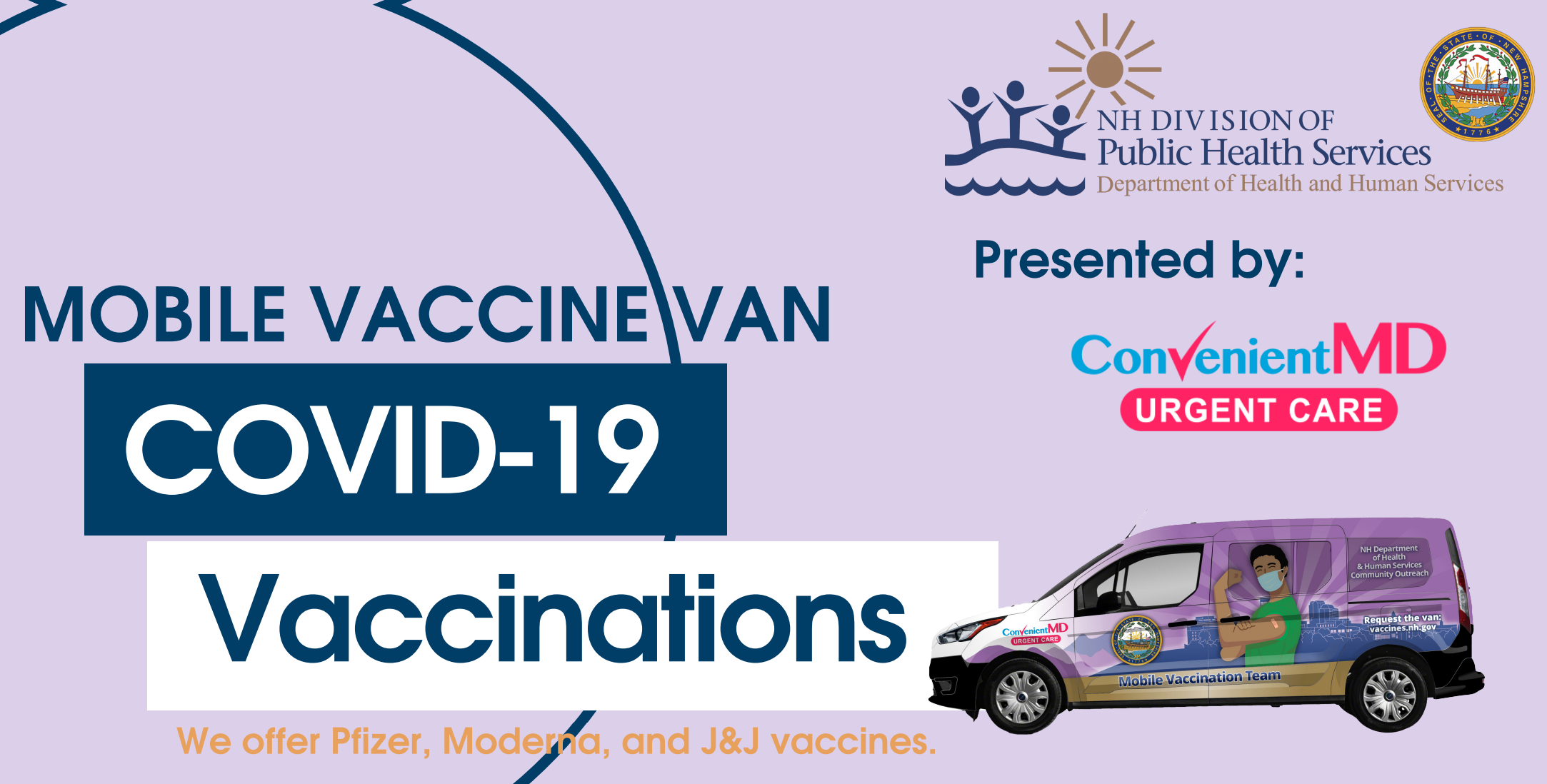
The New Hampshire Department of Health and Human Services is offering free and convenient Covid-19 vaccination via mobile vaccination van. Walk-ins are welcome, no scheduling necessary, and vaccination is free and available to anyone 12 years of age and older. No health insurance needed. The mobile vaccine van offers Pfizer, Moderna and J&J vaccines.
Want to schedule the mobile vaccination van for an event or group? The van is available upon request for any size group across the state of NH at no cost. To request the mobile vaccine van, visit vaccines.nh.gov