Welcoming NH May Table
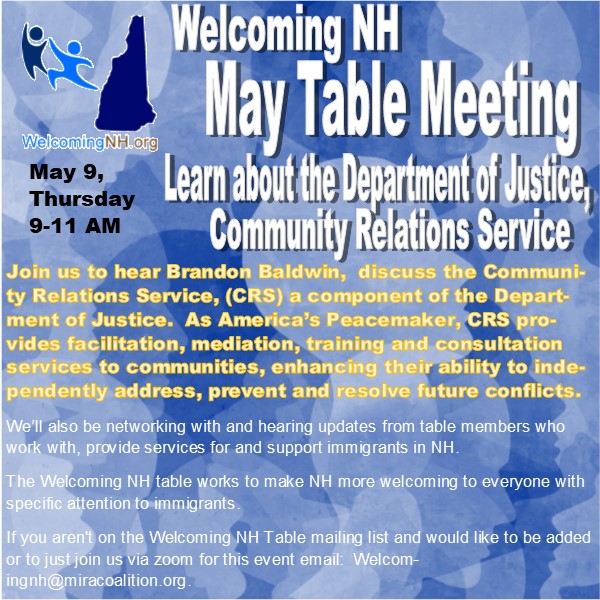
This Thursday, May 9, 9-11 AM via zoom.
Email dholt@miracoalition.org to be sent the Zoom link and be added to the email list.

This Thursday, May 9, 9-11 AM via zoom.
Email dholt@miracoalition.org to be sent the Zoom link and be added to the email list.
COPYRIGHT © 2024 IMMIGRANT LEGAL RESOURCE CENTER | FEBRUARY 2024 1
USCIS PUBLISHES FINAL FEE
RULE, EFFECTIVE APRIL 1, 2024
The Good, the Bad, Who Should File Now, and Who Should
Wait to File
By Ariel Brown and Liz Taufa
Click the Welcoming NH Logo to go to the Rules
On January 31, 2024, USCIS published its final rulei on fee changes for applications, due to
take effect on April 1, 2024. For quick review, see the table of fee changes at 89 Fed. Reg.
6198-6204 or on USCIS’s FAQs on the new fee rule at https://www.uscis.gov/forms/filingfees/frequently-asked-questions-on-the-uscis-fee-rule.
This high level practice alert provides a brief summary of the key changes and some quick
takes for practitioners, including who may want to wait until the new rule takes effect to file in
order to benefit from lower fees or other more advantageous policies, as opposed to prioritize
filing before the fee rule goes into effect on April 1. We will update our website soon with more
details and resources on the fee rule.
The Bad News
Today, the Department of Homeland Security announced a temporary final rule will be published on Monday, April 8, 2024, extending work permits for 540 days for immigrants whose work permit renewal applications are stuck in processing backlogs. You can read the rule here.
For more information check out this article in The Hill: Biden extends some immigrant work permits, potentially saving thousands of jobs
By Jeff Thielman, President and CEO at the International Institute of New England

For those of us who feel strongly about advocating for the rights and protections of refugees and immigrants, the reasons we do so are deeply human. Refugees and immigrants endure long and often dangerous journeys to the U.S. because they have no other choice. Reeling from recent trauma and arriving with very few resources and connections, individuals and families show extraordinary bravery and resilience. Welcoming and supporting them is a moral imperative.
However, in addition to the humanitarian reasons, there are clear economic reasons to embrace newcomers. Numerous recent reports have illuminated the critical role refugees and immigrants have historically played in growing our nation’s economy and the contributions they will make in the years to come. Read on to discover why welcoming immigrants to our communities is not only right in principle, but also the smart thing to do…
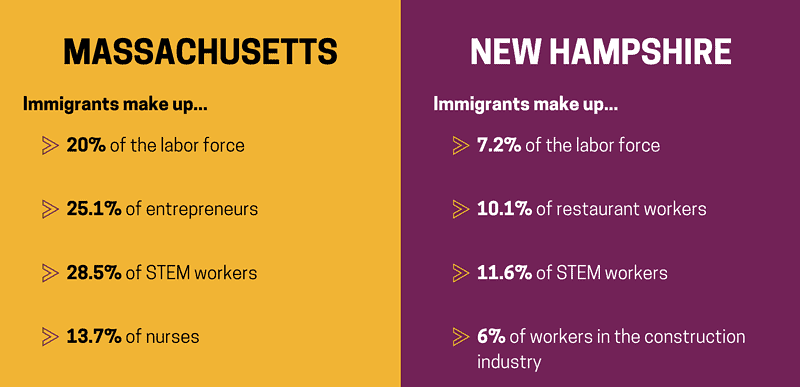
Nationwide, there are two open positions for every jobseeker – a labor gap that is expected to persist for years, as the economy recovers from the COVID-19 pandemic. The arrival of refugees and immigrants is critical to narrowing this gap. By filling roles in a range of industries, from healthcare to STEM, construction, environmental services, and more, newcomers bring skilled expertise and growth to our labor force.
Source: American Immigration Council
In addition, immigrants are highly entrepreneurial and start businesses at a much higher rate than U.S.–born residents. 22% of entrepreneurs nationwide—3.4 million people—were born outside of the U.S.
While refugees and immigrants receive modest help from the government upon arrival, the economic contributions they go on to make far outweigh that initial support. When I speak with our clients, so often one of the first things they tell me is how eager they are to gain work authorization, find a job, and support their families. And you can see that in the numbers.

A new report found that from 2005-19, refugees and asylees paid more in taxes than the government spent on them. In addition, refugees and asylees who have been in the U.S. for ten or more years earn the same level of income, on average, as the general population, and because a larger portion of this population is of working age, refugees and asylees contribute more per capita than the U.S.–born population.
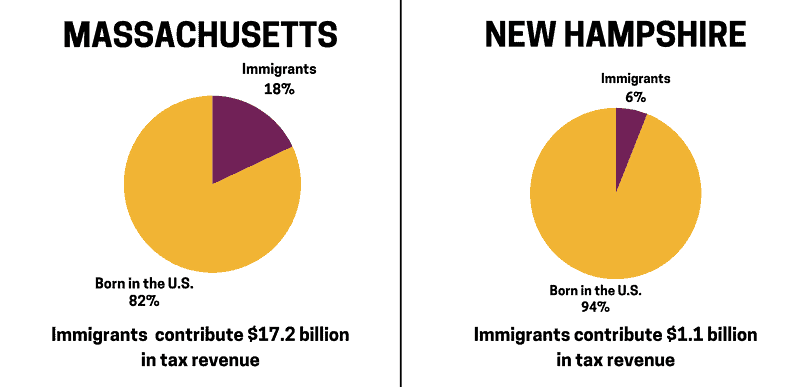
Take Massachusetts, for example. Since 2020, the state has lost almost 110,000 residents. Out-migration is at its highest peak in 30 years. At the same time, the state’s population is aging, and the birth rate is declining. Meanwhile, just north in New Hampshire, while out-migration may not be a cause of concern, the average age of the state’s population is. As the second oldest state in the country, New Hampshire’s workforce is aging rapidly. Not only is there room in our country for people who arrive here seeking safety, we need them to ensure the growth of our economy.
• • •
Refugees and immigrants come to the U.S. when remaining in their home countries is no longer a viable option – because of fear of persecution, because of war, and because of immense, life-threatening dangers. When they do, in addition to deeply enriching the culture, society, and diversity of the communities they join, they help build a more prosperous future for us all.

However, in order to successfully integrate into their new communities, join the workforce, and reach their potential, refugees and immigrants need adequate early support. The International Institute of New England is dedicated to providing our clients with a strong foundation so they can go on to achieve their dreams and contribute to their new communities.
Stats to Understand U.S. Immigration and Immigrants to the United States.
Review U.S. Census data on immigrants and the native born based on demographics (population and country of birth, age, Hispanic origin, children/ families); language and education (English proficiency and educational attainment, languages spoken at home); workforce (immigrants’ share of workers, top occupations and industries, skill underutilization of the college educated); and income (average incomes, poverty rates).
https://www.migrationpolicy.org/data/state-profiles/state/demographics/NH//
Sources: Migration Policy Institute tabulations of the U.S. Census Bureau’s American Community Survey (ACS) and Decennial Census. Unless stated otherwise, 2022 data are from the one-year ACS file. For information about ACS definitions, click here. For ACS methodology, sampling error, and nonsampling error, click here. Estimates from 1990 and 2000 Decennial Census data as well as ACS microdata are from Steven Ruggles, Sarah Flood, Matthew Sobek, Daniel Backman, Annie Chen, Grace Cooper, Stephanie Richards, Renae Rogers, and Megan Schouweiler. IPUMS USA: Version 14.0 [dataset]. Minneapolis, MN: IPUMS, 2023. https://doi.org/10.18128/D010.V14.0.

International Mother Language Day is a worldwide annual observance held on 21 February to promote awareness of linguistic and cultural diversity and to promote multilingualism.

https://www.pbs.org/newshour/politics/whats-in-the-senates-118-billion-border-and-ukraine-deal
National Resource Center for Refugees, Immigrants, and Migrants (NRC-RIM)

National Resource Center for Refugees, Immigrants, and Migrants (NRC-RIM)

National Resource Center for Refugees, Immigrants, and Migrants (NRC-RIM)