In 2025, there were a few congressionally passed changes to immigration laws, including the Laken Riley Act and increased funding for enforcement in HR 1 (aka One Big Beautiful Bill Act). However, some of the more dramatic changes were shifts in how legal policies are interpreted. The change in interpretations and departure from longstanding norms has created a lot of confusion.
“The biggest change is the fear, just the sort of overall nerves and panic that people are feeling, and they’re not wrong,” says Ron Abramson, an immigration attorney with Shaheen & Gordon.
“We’ve dealt with people getting detained illegally and are spending a lot more time in federal court than we ever did before, challenging what we frame as unlawful detention cases, where suddenly the government’s reinterpreting statutes that had been interpreted a certain way for 30 years.”
So far, immigration attorneys are winning those challenges, Abramson said: “By and large, the overwhelming majority of federal judges around the country who have considered the issue have disagreed with the government’s interpretation and granted what’s called habeas corpus relief and either ordered that people get bond hearings in immigration court or just ordered them released.”
Immigration policy’s impact on community
The cascading impact of the shifting immigration landscape has impacts beyond immigrants to our wider communities, schools and states. This has a disproportionate impact on communities of color and mixed-status families.
While immigration is a federal issue, the repercussions of these laws and policy interpretations are felt at the state and local levels.
More than a dozen town and county police departments, plus the New Hampshire State Police, have signed agreements under the 287(g) program to assist with Immigration and Customs Enforcement (ICE) detentions.
While some lawyers may specialize in niche areas of immigration law — only entertainer visas, for example — immigration lawyers in New Hampshire, like Abramson, are often covering a range of issues.
Xiaotian Liu (center) speaks at a press conference with Ron Abramson (left), of Shaheen & Gordon, and Gilles Bissonnette, legal director of the ACLU of New Hampshire. Liu challenged a Trump administration move to cancel his record of immigration in an online database, on April 22, 2025. Photo/ Granite State News Collaborative Partners
“I do everything from family-based immigration to citizenship, to removal defense, to business visas (both immigrant and non-immigrant), to a lot of general advice,” Abramson said. “I end up spending a fair amount of time advising criminal defense lawyers and individuals about how to minimize adverse immigration consequences if they do get into trouble.”
Within the complexities and layers of immigration law, one slight misstep — from a late form to a traffic ticket — can create a devastating impact on a person’s legal status or ability to navigate everyday life.
Abramson said that most people are trying their best to follow the law. Immigration is a civil issue, but it can feel more severe in that it lacks the due process procedures that criminal cases have.
“If you are potentially detained or going to be incarcerated for a criminal case, you have the right to a court-appointed lawyer, a constitutional right to remain silent, suppression issues for any illegally obtained evidence, the list goes on,” Abramson said. “Immigration doesn’t provide those protections.”
New Hampshire’s impact on immigration law
New Hampshire has found itself in the spotlight in at least three major challenges to policy concerns related to immigration and citizenship.
The American Civil Liberties Union of New Hampshire joined other organizations on behalf of the New Hampshire Indonesian Community Support in a challenge to President Donald Trump’s day-one executive order that sought to strip certain babies born in the United States of their U.S. citizenship.
Trump’s order seeks to end birthright citizenship — the guarantee of citizenship to almost everyone born in the United States. Some 30 countries offer birthright citizenship.
Under the order, which has never gone into effect, people born in the country would not be automatically entitled to citizenship if both parents were here illegally or temporarily. The challengers argue that the order conflicts with the 14th Amendment of the Constitution and the court’s longstanding case law.
Among the families impacted by this lawsuit are members of the New Hampshire Indonesian Community Support. One couple arrived in 2023, applied for asylum, and their application is awaiting review while the expectant mother was in her third trimester. If this executive order had been allowed to take effect, the baby would have been considered an undocumented non-citizen and could be denied basic health care and nutrition, putting the newborn at grave risk at such a vulnerable stage of life.
The U.S. Supreme Court is expected to hear arguments on this case in 2026.
The fragility of legal status
In the spring, a Dartmouth College researcher was among thousands of international students whose visa status was revoked without notice.
ICE had begun terminating thousands of students’ Student and Exchange Visitor Information System (SEVIS) records, in many cases over what lawyers say were minor disciplinary records that the government uncovered after running background checks. Dozens of judges had issued temporary holds before the federal government restored the records.
Xiaotian Liu had been able to continue his studies and work under such a temporary order, and by August had his record fully restored. During these proceedings while Liu’s SEVIS record was deleted, his F-1 student status was never terminated.
In this case, Liu had not done anything wrong, but a bureaucratic update threw his work and studies into jeopardy and required time and finances from him, the school, law firms and the government to correct.
A resolved issue resurfaces
Over the summer, a lawful permanent resident of Peterborough, NH, was detained at the U.S.-Canadian border over old misdemeanor offenses. Christopher Landry, then 46, has lived in the United States as a green card holder since he was 5. He is married and has three children, who are all U.S. citizens. Landry pled guilty to misdemeanor drug charges in his 20s. After visiting family in his native Canada, he was prevented from reentering the United States. Ultimately, he was able to get those old charges vacated on the grounds of insufficient counsel under the Sixth Amendment and allowed to return home after about a month.
“While many U.S. citizens might pursue an annulment of criminal charges to negate the impact of a poor decision they made years ago, immigration law does not recognize such annulments. The age of the convictions and subsequent years of law-abiding behavior do not matter to immigration authorities,” Abramson said in a statement at the conclusion of this case. “An individual must instead demonstrate that there was a defect in the original conviction, as we have shown in Mr. Landry’s case.”
This is another example of how an immigrant who has been a model resident for two decades could be separated from his family for an extended time over what would be a small legal issue otherwise.
Christopher Landry, who holds a green card and has lived in Peterborough for 43 years, had been denied reentry to the United States due to past misdemeanor charges. Photo/ Granite State News Collaborative Partners
“There are a lot of people who are following the law as laid out and established for years, decades or longer, who are finding themselves in immigration custody because of different enforcement priorities or these reinterpretations of custody rules,” Abramson said. “Again, most of those challenges are successful because courts — actual courts, not immigration courts, which are administrative — are determining that folks’ due process rights are being violated constantly.”
Ripple Effects of shifting interpretations
These detainments and paperwork challenges raised concerns, not just for immigrants in the United States but also for citizens.
“The most unprecedented shift this year has been the number of panicky American citizens, both naturalized and natural born, who are worried about getting in trouble, either for a protest-related activity or being unable to return after international travel,” Abramson said. “And there was a wave of those kinds of calls; there were just dozens and dozens.”
The federal immigration rhetoric has increased stress, particularly for non-white people living here. Abramson believes that much of the rhetoric is fueled by a lack of nuance.
“There’s a lot of ignorance,” he said. “Some of that is sort of willful, and some of that is just people are not interested in understanding any of these issues. The biggest one is, there is ‘breaking the law’ and there is criminal behavior, and those are not always the same thing.”
Under an administration that is doubling down on enforcement, it’s critical that non-citizens living in the United States — whether refugees, asylum seekers, visa holders or green card holders — stay current on all paperwork renewals. Even one late form can snowball into issue obtaining legal identification, licenses, or school or work permits.
“The concrete takeaways are, if you are not a U.S. citizen, regardless of your status, you need to consult with somebody who knows about this to make sure you’re OK,” Abramson said.
As with some of the previously adjudicated cases in New Hampshire and the country this past year, small conflicts can quickly have outsized consequences. Increased volume of immigration cases will also mean it will be slower and more expensive to resolve cases.
“What we have had to prepare people for is that things are going to be harder. They’re going to take longer. They’re going to be more expensive when we’re talking about our fees and our time,” Abramsom said. “The more the government moves personnel and resources into investigations and enforcement, that’s fewer resources they’re dedicating to service and benefits. So that means processing times are longer than they’ve ever been. … The takeaway is be prepared. Be proactive. Don’t be reactive. If a person who’s not a U.S. citizen gets into even very minor trouble, even if it’s a misunderstanding, they should consult with a lawyer who knows about immigration and criminal law, because very small legal problems can have huge ramifications.”
The public charge ground of inadmissibility refers to the legal standard that determines whether an individual is likely to become dependent on government assistance for their basic needs. Under U.S. immigration law, specifically INA § 212(a)(4), applicants for visas or green cards must demonstrate that they are not likely to become a public charge at any time in the future. This rule applies primarily to family-based green card applications, and if an individual is deemed likely to become a public charge, they may be denied admission to the United States or adjustment of status. The public charge determination considers factors such as age, health, family status, financial resources, and education.
NPRM comment period:
Written comments on the NPRM must be submitted on or before December 19, 2025. The electronic Federal Docket Management System will accept comments prior to midnight eastern time at the end of that day.
This digital toolkit offers ways to uplift our network and partners’ citizenship day activities throughout the month of September. Together, we hope to encourage eligible lawful permanent residents to take the final step on their immigration journey by highlighting the benefits of citizenship. In this toolkit you will find:
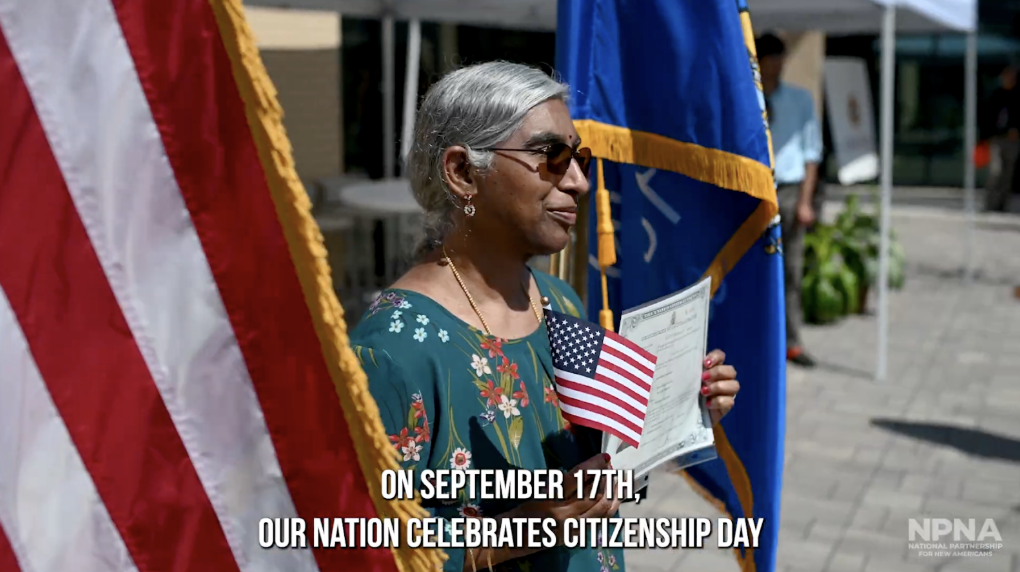
Wednesday, September 17th, 2025 is Citizenship Day, but National Partnership for New Americans (NPNA) and Cities & Counties for Citizenship (CC4C) are taking it a step further and proclaiming the month of September to be “Citizenship Month”. A month to celebrate new Americans who have taken the step to become U.S citizens, encourage eligible immigrants to become U.S. citizens, and celebrate what it means to be a U.S. citizen in a multiethnic, multicultural democracy.
Promoting Citizenship in this Moment
It is not an ordinary time and we fully acknowledge the grave threats facing immigrant communities across the nation. At the same time, we believe it’s important for organizations to continue to encourage eligible residents to become citizens as this continues to be the strongest protection from deportation. Below we offer ways to hold these two truths in a way that shows unity and solidarity.
Necessary precautions, increase screening & preparation support for LPRs
Access Trusted Legal Support: It is more important than ever for people to consult with an attorney or a DOJ Accredited Representative before submitting their application for naturalization. Find a trusted legal service provider here: https://readytostay.org/find-help
Assess Risks: Check out this resource which offers tips on risk assessment for naturalization applicants
Knowledge is Power:
Stay up to date in the event of changes to the naturalization test. While it has been announced that these may change although no further details or dates have been announced.
Know the latest changes to the process/ eligibility. Ex: Recent announcement of new criteria for determining “good moral character.”
Check out this explainer put together by NPNA and partners on denaturalization for practitioners and stay up to date on the latest developments
We advocate to protect our communities and to protect citizenship
An injury to immigrants of any status is an injury to all of us. Let’s ensure that in our messaging we are not differentiating between protection for those who have lawful pathways and those who don’t.
Citizenship itself has been and will likely continue to be under threat and we must continue to advocate to keep it as accessible as possible.
Encouraging those eligible to naturalize to seek a trusted provider for legal services and support
In this rapidly changing policy landscape, the evergreen call for permanent protections is more important than ever. Citizenship remains an important way to attain permanent status for those who are eligible. Here are some of the benefits to uplift at this time:
Right to vote
US passport allows you to travel and return more safely
Adjust status for family members
Likelihood to increase annual earnings
II. How to engage in Citizenship Day 2025
On September 17, 2025 the nation observes citizenship and constitution day- a day that immigrant rights advocates have adopted to uplift a unified rallying call to action for the more than 9 million people eligible to naturalize across the nation.
We hope your organization will join us- especially if you have upcoming naturalization events, ongoing classes, or citizenship clinics.
Here are 3 ways to participate:
Share our “Call to Naturalize [English | Spanish Subs HERE]” video on your social media on Wednesday September 17, 2025 and join dozens of other organizations as we create momentum on socials to reach a wide range of community members with this important message.
Today on #CitizenshipDay2025 we recognize that naturalization is more than a status change; it is a declaration of belonging. It ensures that our communities are not just spoken about, but are the ones speaking, deciding, and shaping the future. YOUR ORG NAME is proud to join @npnewamericans on this national day of action as we stand united to #ProtectCitizenship and support community members on their journey to naturalization.
ADD INFO HERE ABOUT AN UPCOMING CITIZENSHIP EVENT OR CLASSES / PROGRAMMING HELD BY YOUR ORG OR LOCAL PARTNERS OR OTHER CALL TO ACTION THAT BRINGS PEOPLE INTO YOUR WORK.
Holding a naturalization event and sharing on social media? Be sure to tag @npnewamericans so that we can uplift.
Post and share digital content from this toolkit (see next section) all month long!
On July 14, the U.S. Department of Health and Human Services (HHS) published a notice in the Federal Register that re-interprets the meaning of “Federal public benefit” in the 1996 welfare law. In doing so, the notice restricts eligibility to a narrow set of “qualified immigrants” and leaves out many lawfully residing immigrants. See Table B below for more details.
The notice takes effect on July 14, 2025, but HHS also provides a 30 day comment period that ended on 8/13/2025. The PIF Coalition comment signed by nearly 400 organizations is available here. Update 8/7/25: HHS posted an update that, on a nationwide basis, it will not enforce this notice until September 11, 2025. This is likely in response to a lawsuit filed by 21 states against the Trump administration to block the notice. As part of the lawsuit, the states and HHS recently agreed to a stipulation that HHS would not enforce the PRWORA notice until September 11th in the states that are plaintiffs in the lawsuit. In other words, the notice does not apply until September 10th in the following states: Arizona, California, Colorado, Connecticut, District of Columbia, Hawaii, Illinois, Maine, Michigan, Massachusetts, Maryland, Minnesota, Nevada, New Jersey, New Mexico, New York, Oregon, Rhode Island, Vermont, Wisconsin, and Washington. Learn more about the notice in our explainer below.
The notice says that HHS considers an additional 13 programs as “Federal public benefits” with eligibility restricted to qualified immigrants. These include Head Start, Community Health Centers, the Title X family planning program, and the Community Services Block Grant (CSBG). See Table A below for more details. HHS also recognizes that some services designated as “federal public benefits” may nevertheless fit within one of the statutory exemptions, such as testing and treatment of communicable disease symptoms. This notice does not change eligibility for Medicaid or CHIP and states that provide coverage to lawfully residing immigrant children and pregnant people can continue to do so.
This HHS notice did not address PRWORA’s verification requirements. It confirms that non-profit charitable organizations are not required to verify immigration status. But it did not provide details on how verification of status might occur.
More Details
Programs HHS Considers as Federal Public Benefits
The 1996 welfare law provided a general definition of the “Federal public benefits” that are subject to its “qualified immigrant” eligibility restrictions. With some important exceptions, the welfare law allowed Federal agencies to determine which of their programs were restricted by the law and which were exempt from restriction.
On July 14, 2025, almost thirty years after passage of the 1996 welfare law, and more than 25 years after HHS published its initial notice, the agency published a notice reinterpreting this term. The notice takes effect immediately (based on the rationale that any delay would be contrary to the public interest and fail to address the ongoing emergency at the Southern Border of the U.S.), but also grants a 30 day comment period.
Table A below lists the programs that HHS considered to be “Federal public benefits” in the initial August 4, 1998 notice , and in the notice published on July 14, 2025. “Federal public benefits” are subject to “qualified immigrant” eligibility restrictions. The notice says that this list is not exhaustive. Any programs not listed in this notice or established after the date of this notice may still fall under the definition of Federal public benefit. Any additional programs determined to be Federal public benefits will be announced in program specific guidance. However, the notice does not change eligibility for Medicaid or CHIP and states that cover lawfully residing immigrant children and pregnant people can continue to do so.
In the July 10, 2025 notice, HHS’ recognized that some services designated as “federal public benefits” may nevertheless fit within one of the statutory exemptions, such as testing and treatment of communicable disease symptoms.
Qualified Immigrants
“Qualified immigrants” under the welfare law –the Personal Responsibility and Work Opportunity Reconciliation Act of 1996 (PRWORA) – are eligible for Federal public benefits programs. They include lawful permanent residents (LPRs) or people with a green card, refugees, people granted asylum or withholding of deportation/removal, and conditional entrants; people granted parole by the U.S. Department of Homeland Security (DHS) for a period of at least one year; Cuban and Haitian entrants; certain abused immigrants, their children and/or their parents; certain survivors of trafficking; and individuals residing in the U.S. pursuant to a Compact of Free Association (COFA).
Many lawfully residing immigrants, who are not listed as “qualified immigrants,” are ineligible for “Federal public benefits” programs. These immigrants include people with Temporary Protected Status; applicants for adjustment to LPR status with approved visa petitions; applicants for asylum or withholding of deportation/removal; people paroled for less than one year, granted deferred enforced departure, or deferred action; special immigrant juveniles; U Visa Holders, people with valid nonimmigrant visas, and more.
Table B Below provides details.
Verification Requirements
This HHS notice did not address PRWORA’s verification requirements. It confirms that non-profit charitable organizations are not required to verify immigration status. But it did not provide details on how verification of status might occur.
Costs and Savings
In addition to any savings that may be achieved by excluding lawfully residing people from health and human services programs, HHS notes millions of dollars in new administrative costs for individuals to document their eligibility, and the government to review their eligibility, and for programs to revise their eligibility and operating procedures.
Table A: Programs HHS Considers to Be “Federal Public Benefits” Restricted to “Qualified” Immigrants
Administration on Developmental Disabilities – State Developmental Disabilities Councils (direct services only)
✔️
✔️
ADD– Special Projects (direct services only)
✔️
✔️
ADD- University Affiliated Programs (clinical disability assessment services only)
✔️
✔️
Adult Programs/ Payments to Territories
✔️
✔️
Agency for Health Care Policy and Research Dissertation Grants
✔️
✔️
Child Care and Development Fund
✔️
✔️
Clinical Training Grant for Faculty Development in Alcohol and Drug Use
✔️
✔️
Foster Care
✔️
✔️
Health Profession Education and Training Assistance
✔️
✔️
Independent Living Program
✔️
✔️
Job Opportunities for Low Income Individuals (JOLI)
✔️
✔️
Low Income Home Energy Assistance Program (LIHEAP)
✔️
✔️
Medicare
✔️
✔️
Medicaid (except assistance for an emergency medical condition)
✔️
✔️
Mental Health Clinical Training Grants
✔️
✔️
Native Hawaiian Loan Program
✔️
✔️
Refugee Cash Assistance
✔️
✔️
Refugee Medical Assistance
✔️
✔️
Refugee Preventive Health Services Program
✔️
✔️
Refugee Social Services Formula Program
✔️
✔️
Refugee Social Services Discretionary Program
✔️
✔️
Refugee Targeted Assistance Formula Program
✔️
✔️
Refugee Targeted Assistance Discretionary Program
✔️
✔️
Refugee Unaccompanied Minors Program
✔️
✔️
Refugee Voluntary Agency Matching Grant Program
✔️
✔️
Repatriation Program
✔️
✔️
Residential Energy Assistance Challenge Option (REACH)
✔️
✔️
Social Services Block Grants (SSBG)
✔️
✔️
State Child Health Insurance Program (CHIP)
✔️
✔️
Temporary Assistance for Needy Families (TANF)
✔️
✔️
Title X Family Planning Program
✔️
Head Start
✔️
Title IV-E Educational and Training Voucher Program
✔️
Community Services Block Grant (CSBG)
✔️
Health Center Program
✔️
Substance Use Prevention and Recovery Support Services Block Grant
✔️
Community Mental Health Services Block Grant
✔️
Projects for Assistance in Transition from Homelessness Grant Program
✔️
Certified Community Behavioral Health Clinics
✔️
Mental Health and Substance Use Disorder Treatment, Prevention and Recovery support Services Programs administered by the Substance Abuse and Mental Health Services Administration not otherwise covered under 37-40.
✔️
Title IV-E Prevention Services Program
✔️
Title IV-E Kinship Guardianship Assistance Program
✔️
Health Workforce Programs not otherwise covered under 10 above (including grants, loans scholarships, payments and loan repayments).
✔️
Note 1: The notice says that this list is not exhaustive. Any programs not listed in this notice or established after the date of this notice may still fall under the definition of Federal public benefit. Any additional programs determined to be Federal public benefits will be announced in program specific guidance.
Note 2: The notice does not change eligibility for Medicaid or CHIP and states that cover lawfully residing immigrant children and pregnant people can continue to do so.
Table B: Qualified Immigrants and Lawfully Residing Immigrants
Qualified Immigrants
Lawfully Residing Immigrants
Lawful permanent residents (LPRs) or people with green cards
✔️
✔️
Refugees and people granted asylum
✔️
✔️
People granted withholding of deportation/removal,conditional entrants
✔️
✔️
People granted parole by the U.S. Department of Homeland Security (DHS) for a period of at least one year;
✔️
✔️
Cuban and Haitian entrants;
✔️
✔️
Certain abused immigrants, their children and/or their parents;
✔️
✔️
Certain survivors of trafficking;
✔️
✔️
Individuals residing in the U.S. pursuant to a compact of free association (COFA).
✔️
✔️
People with Temporary Protected Status
✔️
Applicants for adjustment to LPR status with approved visa petitions
✔️
Applicants for asylum or withholding of deportation/removal
✔️
People paroled for less than one year, with deferred enforced departure, or deferred action
✔️
Special immigrant juveniles
✔️
U Visa Holders
✔️
People with valid nonimmigrant status or nonimmigrant visas
✔️
Longtime Residents
✔️
People under an order of supervision who have employment authorization
✔️
People granted Family Unity
✔️
Applicants for the following statuses, who have been granted employment authorization:Cancellation of removal or suspension of deportationAdjustment under the LIFE ActLawful Temporary Residents and Applicants for Legalization under the IRCARegistry